Building SiliconJackets
Starting and Growing the Largest Student Run Semiconductor Engineering Organization in America
My first exposure to VLSI came in ECE 270 at Purdue, where, toward the end of the course, we designed and simulated a basic calculator in Verilog. That experience immediately clicked for me. This kind of “programming” felt far more intuitive than the software I had worked with before. My interest quickly deepened the following semester in ECE 337, where I learned the fundamentals of digital design and the RTL to GDS flow under the guidance of one of my long-time mentors, Dr. Mark Johnson. But after that, there was a gap. Despite my growing interest, I found it difficult to continue learning independently. The tools and resources I needed were largely inaccessible and locked behind licenses and NDAs. Compared to other areas of engineering I had explored before (3D printing, PCB design, automotive engineering, etc.) VLSI felt uniquely inaccessible. I began engaging with existing resources in the space and even tried to build my own. I participated in the Google/Skywater OpenMPW program and began to engage more with SoCET at Purdue. As a member of SoCET I couldn’t help but compare the experiences I had within this university organized team to my time in Purdue Electric Racing as a primarily student run organization. The contrast was striking. The level of ownership, autonomy, and hands-on experience in a student-driven environment was fundamentally different. When I made the move to Georgia Tech for my graduate degree, I knew I had to take what I learned in those spaces and see if I could apply them to a new concept: an entirely student run project team focused on semiconductor engineering.
Preliminaries
The process of building the student organization began many months before welcoming new members. My cofounder, Nealson, and I started by defining the core tenets of the organization and how we wanted it to operate. This step proved critical, not only for internal alignment but also for establishing legitimacy early on. When engaging with university administration and potential corporate sponsors, it helped that we had already thought through our structure, operating procedures, and the challenges we expected to face. Many people supported us not because we had already built something, but because we appeared prepared to do so. Securing early support from key stakeholders within the university, especially in the ECE department, gave us a strong foundation to build on.
Recruiting the initial leadership team was a challenging and, at times, tense process that began in midsummer 2023. Although Nealson and I were familiar with the university, our pool of candidates was smaller than expected. Many of the most technically capable individuals were more interested in pursuing their own projects than taking on leadership roles. At the same time, some who were eager to get involved struggled to meet the demands of the role. One lesson that has remained consistent is that it is impossible to assemble a team of perfect leaders. People bring different strengths and limitations. Some are highly technical but struggle to delegate. Others understand the big picture but lack attention to detail. Some are simply inconsistent. As a leader, it is important to recognize these differences and make effective use of the team you have. If someone contributes value, find a way to leverage it. If they do not, be willing to let them go. A unique challenge of a voluntary organization like SiliconJackets is that participation in our shared effort has no bearing on the livelihood of anyone. Especially in the early days of the organization when it was not as well-known and had minimal impact on job prospects, contributions were driven almost entirely by intrinsic motivation. Because of this, one of our core principles has been not to squeeze everyone for their last drop of juice, but to push them into an environment where they want to grow and build together.
Efficient Scaling
A key component of SiliconJackets’ operating procedure is keeping scale in mind. Whenever we evaluate a new service or standard for the organization, we consider how it will perform with 100 or more active students, and whether there is a solution that can scale automatically. SiliconJackets, like any student organization attempting to replicate its structure, operates within a university ecosystem that already standardizes many software services under a Single Sign-On (SSO) system. By leveraging university servers as a workspace, university-managed GitHub for version control, and institution-supported tools for documentation, we minimize the overhead required to scale the organization to any number of contributors.
The foundation of this approach is the onboarding project. Onboarding has been a central topic of discussion and refinement among leadership since the organization’s inception, and it serves as the stabilizing structure that enables everything else to function. The onboarding process is designed to achieve two goals. Firstly, it acts as a weed-out measure for the organization. However, it is not a traditional weed-out process that relies on difficulty or technical depth. Instead, the tasks are intentionally accessible, even to students with little or no prior experience. By setting a low barrier to entry and requiring prospective members to complete a small set of tasks within a defined timeline, onboarding evaluates effort and follow-through rather than existing skill. This approach has proven useful beyond the organization as well. In many situations, the way someone engages with simple tasks such as scheduling meetings or proofreading their own communication can be a strong signal of how effectively they will use resources contributed towards them. The second goal of onboarding is to handle technical challenges efficiently. The onboarding project is structured as a compact set of tasks that collectively cover the tools used across a given role. Running this process at scale allows us to amortize the cost of troubleshooting. If 100 people are onboarding simultaneously and 50 encounter the same issue, resolving it once effectively resolves it for all affected members. In its current form, SiliconJackets is able to onboard more than 100 new members over six weeks, exposing them to digital design, design verification, and physical design.
Originally, members onboarded into only the subteam they were most interested in. Over time, onboarding was expanded to include all subteams. This change addressed a structural issue we observed both within SiliconJackets and in the broader semiconductor talent pipeline. When allowed to choose a subteam based only on prior familiarity, more than two thirds of students default to digital design. By requiring exposure to all areas of the organization, members develop a more complete understanding of the end-to-end design flow, from concept to tapeout, and ultimately make more informed placement decisions.
A significant early mistake that affected productivity in SiliconJackets’ first year was the lack of a clearly defined project specification. The team knew we were building a simple five-stage RISC-V CPU and understood the major components involved. However, planning was treated as if it were a small personal project. As a result, responsibilities were loosely assigned at a high level, but contributors were often unsure how their modules fit into the larger system, who would integrate the design, or how issues should be resolved when they arose. This ambiguity led to paralysis and limited progress. Establishing a clear framework for large-scale projects, whether through detailed documentation or a well-defined module skeleton, significantly reduces the barrier to entry. Transitioning to a system where module inputs and outputs are explicitly defined, and where the path from concept to verified design is clearly documented, has greatly improved execution. It has enabled more than 100 students to work in parallel, make consistent progress, and contribute effectively without waiting for clarification or struggling to understand the boundaries of their responsibilities.
The Value Proposition of SiliconJackets
One of the most common questions I receive from those looking to start similar initiatives is how to approach fundraising and attract corporate sponsors or partnerships. The answer lies in understanding the actual economics of an organization like SiliconJackets, and the value it provides to both academia and industry.
The core product of SiliconJackets is not silicon, it is students.
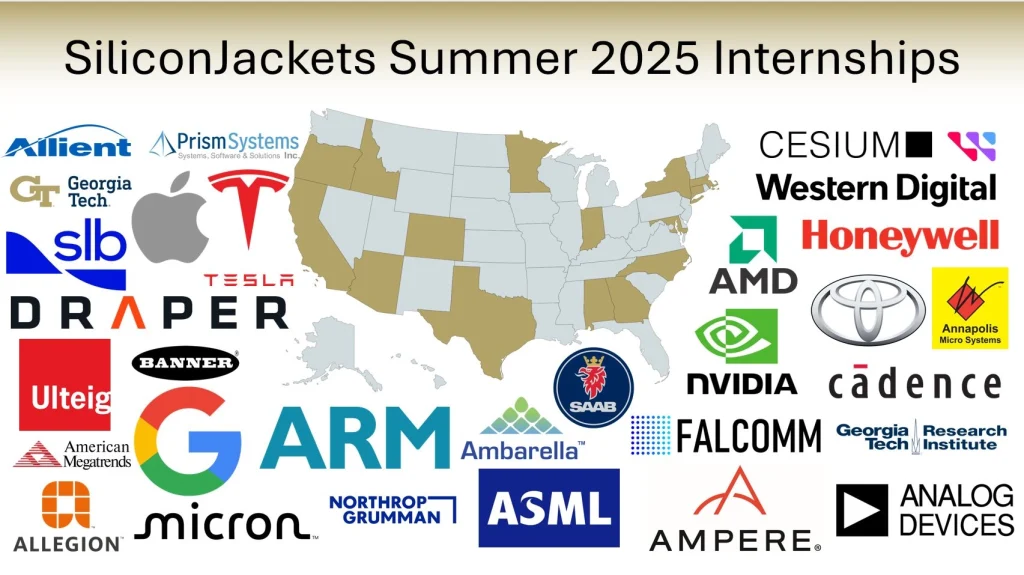
Each year, the organization’s entire technical effort culminates in a tapeout that produces fewer than 50 packaged silicon dies at a cost exceeding $10,000. The direct monetary value of the resulting chips is effectively zero. On the surface, this can appear to be an inefficient use of resources. However, the tapeout serves a different purpose. It is the strongest possible proof that the work is real. A working chip cannot be faked. Despite the rigor of university programs, technical recruiting remains an expensive and time-intensive process for companies. Traditional career fairs often produce limited results, leaving both students and recruiters wanting a more effective process. Through my experience at Purdue Electric Racing, I saw how impactful verifiable, hands-on experience can be in securing positions at highly selective companies and academic institutions. SiliconJackets exists to create a signal to corporations looking to hire. By emphasizing hard work, reliability, and end-to-end execution, SiliconJackets acts as a filtering mechanism that helps companies identify students who can succeed in industry roles. This is reinforced by structuring the organization around industry-standard tools and workflows. By recreating a professional environment, students who transition into industry can ramp up quickly in their new roles. As shown below, SiliconJackets members are able to find employment across a large variety of corporations utilizing their skills.
From a funding perspective, an organization like SiliconJackets is relatively straightforward compared to many other engineering project teams. It can be fully funded, including annual tapeout costs, for under $20,000 per year, roughly five to ten times less than a top-performing Formula SAE team. The dominant cost driver is tapeout fabrication. Operating within a university environment also makes it feasible to minimize software expenses. In SiliconJackets’ case, access to industry-standard tools and infrastructure is provided through the university. Where such access is not available, open-source toolchains and cloud-based or standardized Linux environments can serve as effective alternatives. In general, it is neither practical nor cost-effective for a student organization to self-host or independently purchase commercial EDA tools without institutional support. For SiliconJackets, the first major tapeout was not completed until the end of the second year. Establishing strong operating procedures, consistent output quality, and demonstrated technical competence early on significantly reduces the effort required to secure funding later. Fundraising should be a consequence of maturity, not the starting point. It should not be the first focus when building a similar organization.
The Power of Saying No
Early in building SiliconJackets, before there was significant external interest from students, one of my greatest fears was losing the small group of people who had committed to helping us build something from scratch. Nealson and I were aligned on the mission and how the organization should operate, but each new member brought additional ideas and proposed changes they wanted to incorporate into the vision. I found myself trying to accommodate everyone while also preserving the culture we had originally envisioned. At times, I also struggled to clearly communicate and assert my own perspective. After one of our early leads meetings, a subteam lead who was also a close friend texted me and said I needed to be firmer, and that it did not seem like people were fully respecting my leadership. That feedback made it clear that if I wanted to effectively lead the organization, I needed to be willing to disagree with others in leadership and hold boundaries, even when it was uncomfortable. From that point forward, one of the most common words in my vocabulary became “no.” One of the most difficult aspects of leadership, in my view, is developing good taste. At SiliconJackets, the leadership team met weekly to review high-level progress across subteams and address ongoing issues. As president, my responsibility was to evaluate problems across a wide spectrum, from minor inefficiencies to critical blockers, and help drive them toward resolution. While generating ideas was important for solving problems, I learned that rejecting weak ideas and redirecting effort was often just as impactful, if not more so, in determining the organization’s overall success. One of the strongest leads SiliconJackets ever had frequently brought forward new ideas and directions for the organization. I said no to most of them. However, out of the small subset we chose to pursue, he was able to help transform a subteam that had previously been one of the weakest in the organization, significantly improving both its execution and member retention. Effective leadership is a delicate balance, particularly in a volunteer organization. Many of SiliconJackets’ leads could likely have had greater individual impact through personal projects, rather than through their direct contributions to the organization. However, strong judgment as a leader makes it possible to channel that talent into collective progress. It allows high-agency individuals to contribute meaningfully while still feeling supported and aligned with the broader mission.
The Curse of Founder Led Organizations
In my own life, I have often found that the best advice comes from unexpected places. Those who know me well are aware of my lifelong love for animals, especially primates and, in particular, gibbons. Several years ago, I was invited to attend an annual supporters meeting for a well-established primate sanctuary. The organization had been led by the same founder for over 50 years, and she had recently passed away. The most insightful talk came from the founder of another wildlife sanctuary in Thailand, who spoke about the challenges of founder-led organizations. Without naming specific examples, he described how, when a founder becomes deeply identified with their cause, they can begin to embody the organization itself. This creates risk when they are no longer present. Over the two days I spent at the meeting, I saw this dynamic firsthand. Many attendees focused on emphasizing their personal relationship with the late founder, how close they had been, and how long they had known her. At the same time, the organization itself felt fragmented. Compared to how it had presented itself in the past, it seemed disjointed, and it was unclear who was truly leading. This pattern is not unique to small organizations. There are many large companies and institutions where the founders become larger than the work itself. The paradox is that building something meaningful requires an intense level of personal investment, but sustaining it requires the ability to step back. I spent nearly all my free time for close to a year getting SiliconJackets off the ground. At the same time, I understood that for the organization to grow beyond me, I would eventually need to let go of control.
SiliconJackets, like many student organizations, faces a unique challenge. Even when things are going well, leadership turnover remains high. The strongest leaders often emerge near the end of their degrees and then quickly move on. Over time, I have had the opportunity to see several generations of leadership pass through the organization. Knowledge transfer is a constant challenge, and maintaining continuity at the executive level is difficult to get right. Much of my mentorship style comes from an experience I had at my first job as an apprentice in a mechanic shop. On my first day, I was asked to wash a customer’s car before pickup. I rushed through the task, assuming it was straightforward. The owner inspected my work, pointed out several issues, and asked me to do it again. This process repeated several times until the car was nearly spotless, including areas that were not immediately visible. At the time, it felt excessive, but it left a lasting impression. After that, the owner no longer needed to check my work. The standard had been set. I have tried to apply this approach within SiliconJackets. Being highly exacting at the beginning of a process reduces the need for repeated corrections later and helps establish a standard that can persist across multiple generations of leadership. For me, an important part of building SiliconJackets was not only creating a space where like-minded students could collaborate, but also seeing it grow beyond my direct involvement. I chose to step down from leadership at the end of the 2024 to 2025 academic year for two reasons. First, I wanted to remain present to help guide the transition. Second, I believed the organization needed new leadership with the energy and perspective to push it further. Executive leadership in any organization acts as a gatekeeper for ideas and standards. To lead effectively, you need to be deeply committed to the organization’s values and willing to defend them. After two years, I recognized that I was no longer holding that line as firmly as I once had. While the fluidity of leadership within SiliconJackets presents challenges, it also brings constant renewal. New members introduce fresh ideas, energy, and perspectives that prevent the organization from becoming stagnant. I am excited to see how it continues to evolve.
If there is one takeaway from my experience, it is that building something like SiliconJackets is less about resources and more about structure, standards, and intent. The barriers that seem immovable at first, whether access to tools, funding, or talent, become manageable once a strong system is in place. Focus early on defining how your organization operates, not just what it builds. Design for scale from the beginning. Create a recruitment process that selects for effort and teaches fundamentals. Be deliberate in leadership, even when it requires saying no. And most importantly, build something that can outlast you. If those pieces are in place, the rest will follow.